
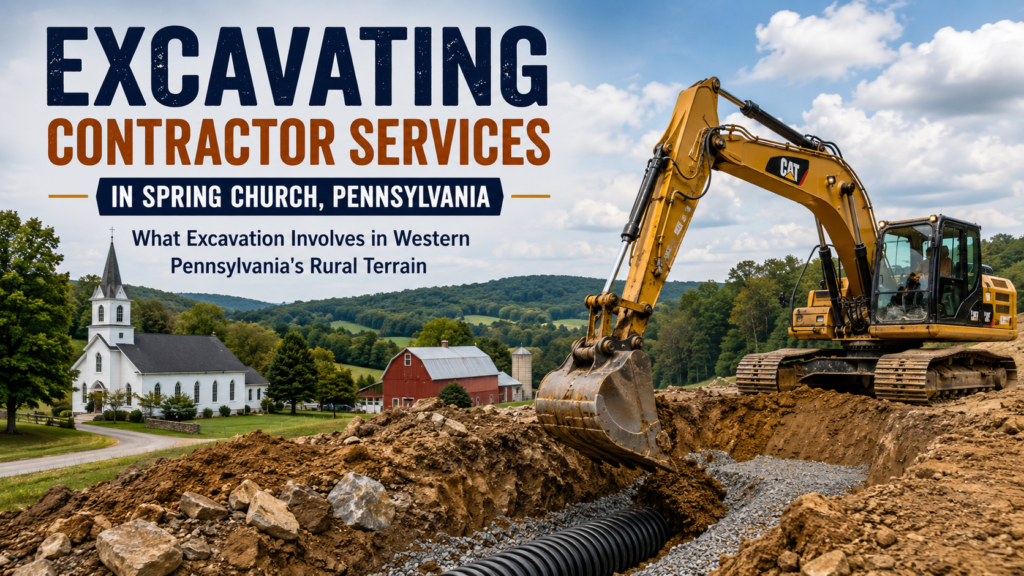
Excavating contractors in Spring Church and the broader Armstrong County region provide the foundational earth-moving and site preparation services that make every type of construction possible. From residential home sites and septic system installations to commercial development and agricultural site work, excavation is the starting point for projects that build, improve, or repair the infrastructure that rural communities depend on. Spring Church’s location along Route 56 in the Kiskiminetas River valley surrounded by the rolling hills and varied geology of Western Pennsylvania creates a specific context for excavation work that differs meaningfully from flat suburban environments. Understanding what Excavating Contractor Spring Church do and what makes their work in this area distinctive helps property owners plan their projects effectively.
What Excavating Contractors Provide
Excavating contractors are heavy equipment specialists who perform earth-moving and below-grade construction operations. In Spring Church and Armstrong County, their services cover:
- Site clearing and grubbing: Removing vegetation, stumps, and surface material from proposed construction areas in preparation for development.
- Rough grading: Reshaping terrain to approximate finished elevations, establishing drainage slopes, and preparing the sub-grade for construction.
- Foundation excavation: Digging the pits and trenches required for building foundations, basement construction, and footings.
- Utility trenching: Excavating trenches for water lines, sewer laterals, electric conduit, gas lines, and telecommunications infrastructure.
- Septic system installation: Excavating the drain fields, tanks, and associated infrastructure for on-site septic systems a critical service in Spring Church’s rural context where municipal sewer service is not universally available.
- Driveway and road base preparation: Excavating and grading for driveway and private road construction, including drainage feature installation.
- Pond and earthwork construction: Farm ponds, retention basins, and drainage improvements are common earthwork projects on rural Armstrong County properties.
- Demolition excavation: Following structural demolition, excavating and removing foundations, buried debris, and contaminated material.
The Geological Character of Armstrong County
Armstrong County’s geology is dominated by sedimentary formations shales, sandstones, and coal-bearing strata characteristic of the Appalachian coalfields region of Western Pennsylvania. This geology creates excavation conditions that differ significantly from those in other parts of the state. Hard sandstone and coal formations can be encountered at shallow depths on hillside properties, requiring rock excavation equipment or blasting in severe cases. Soft shale formations weather rapidly when exposed to air and water, requiring prompt stabilization after excavation. The clay-rich soils overlying the bedrock in valley areas retain water, expand and contract seasonally, and can create challenging bearing conditions for light construction.
Experienced excavating contractors in Spring Church are familiar with these geological conditions and approach their work accordingly planning excavation sequences to manage rock encounters efficiently, specifying appropriate sub-base materials for the local soil conditions, and designing drainage approaches appropriate to the clay content and drainage characteristics of the soils on each specific site.
Septic System Excavation: A Critical Rural Service
In Spring Church and throughout rural Armstrong County, on-site septic systems serve properties that are not connected to municipal sewer infrastructure. Septic system design and installation is regulated by Armstrong County and the Pennsylvania Department of Environmental Protection, and requires site evaluation by a licensed soil evaluator to determine soil percolation rates and the appropriate system design for the site conditions.
Excavation for septic systems involves:
- Septic tank installation: Excavating the pit for the buried tank, installing the precast concrete or polymer tank, and backfilling appropriately.
- Leach field construction: Excavating trenches for the distribution lines and drain field stone at the depth and layout specified in the system design.
- Mound or alternate system construction: On sites with limiting soil conditions high water table, slow percolation, or shallow rock alternative systems may be required that involve constructing an elevated drain field with imported sand fill.
Coordination with Armstrong County’s sewage enforcement officer is required throughout the installation, with inspections at key phases before backfilling covers the installed components.
Pennsylvania One Call (811) and Utility Safety
Before any excavation in Spring Church or anywhere else in Pennsylvania, the Pennsylvania One Call system (811) must be notified at least three business days before digging begins. This notification triggers utility companies to locate and mark their underground infrastructure gas lines, electric conduit, water mains, telephone, and cable with color-coded flags or paint.
In rural Armstrong County, the underground utility infrastructure includes natural gas pipelines (the region has significant natural gas infrastructure related to both distribution and Marcellus Shale production), electric distribution conduit, and telephone/data lines that may follow rural road right-of-ways and cross private properties. Striking an underground utility line during excavation can cause explosions, electrocution, service disruptions, and significant liability. The 811 notification requirement is not bureaucratic formality it is a genuine safety measure that prevents serious accidents.
Drainage: The Defining Challenge of Western Pennsylvania Excavation
Water management is the most consistent technical challenge in excavation work throughout Western Pennsylvania’s hilly terrain. Properties in Spring Church and Armstrong County receive significant annual precipitation approximately 40 inches per year and the rolling terrain concentrates runoff in valleys and hollows where many properties are located.
Excavating contractors in this region address drainage at multiple levels:
- Surface drainage: Grading during site preparation to direct surface runoff away from building areas and toward appropriate outlets.
- Subsurface drainage: Installing perforated drain tile systems to intercept groundwater before it saturates foundation materials or building areas.
- Diversion ditches: Constructing drainage channels above proposed building or paving areas to intercept hillside runoff before it reaches the site.
- Stormwater infrastructure: Culverts, headwalls, and outlet structures that manage concentrated runoff from building areas.
Conclusion
Excavating contractor services in Spring Church are the starting point for the full spectrum of construction and site improvement projects in this rural Armstrong County community. The area’s distinct geology, rolling terrain, rural character, and Western Pennsylvania climate all shape how this work must be approached. Property owners in Spring Church who understand what excavation involves from utility notification through geological challenges to drainage management are better prepared to plan their projects, work effectively with local contractors who know the area, and achieve results that perform reliably through the region’s seasons.